Cyber threats have become more sophisticated, and businesses can no longer rely on a single security tool to protect their networks. While firewalls, antivirus software, and endpoint protection remain essential, they’re only part of a strong cybersecurity strategy. One of the most effective ways to reduce risk is through network segmentation.
Many organizations operate on a flat network where users, devices, servers, printers, and connected equipment can communicate freely. While this setup may seem convenient, it also creates an environment where cybercriminals can move throughout the network if they gain access to a single device.
By implementing network segmentation, businesses can contain threats, protect sensitive information, and strengthen overall resilience. Combined with proactive monitoring and managed network security, segmentation helps organizations improve both security and operational continuity.
What Is Network Segmentation?
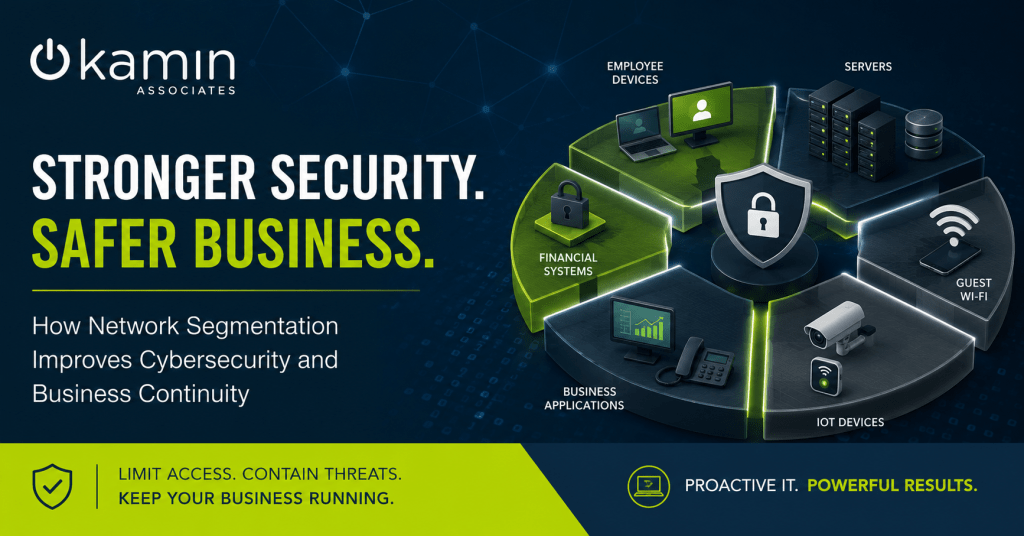
Network segmentation is the process of dividing a computer network into smaller, isolated sections based on users, departments, devices, or business functions.
Instead of allowing every device to communicate with every other device, segmentation creates boundaries that control traffic between different parts of the network. These boundaries are managed through firewalls, virtual LANs (VLANs), access control policies, and other security technologies.
For example, a business may separate:
- Employee workstations
- Financial systems
- Human Resources data
- Servers
- Guest Wi-Fi
- Security cameras and IoT devices
- Production equipment
- Remote user connections
Each segment can have its own security rules and access permissions, reducing unnecessary communication across the network.
Why Flat Networks Increase Security Risks
Imagine someone breaks into a building where every office, server room, and storage area is unlocked. Once inside, they can move anywhere without restriction.
That’s essentially how a flat network operates.
If an employee accidentally clicks on a phishing email or malware infects a workstation, attackers may be able to:
- Access shared folders
- Move to file servers
- Reach financial systems
- Target backups
- Collect employee credentials
- Spread ransomware across the organization
This type of movement is known as lateral movement, and it’s one of the most common tactics used in modern cyberattacks.
Network segmentation limits how far attackers can go, making it much more difficult for an isolated incident to become a company-wide disaster.
How Network Segmentation Helps Prevent Ransomware
Ransomware remains one of the biggest cybersecurity threats facing businesses today. Modern ransomware groups rarely encrypt just one computer—they attempt to spread across the entire network before launching their attack.
With proper network segmentation, ransomware encounters barriers throughout the environment.
For example:
- A compromised employee computer cannot automatically access critical servers.
- Manufacturing equipment can be isolated from office computers.
- Guest wireless users cannot reach internal business resources.
- Backup systems remain protected from infected devices.
Although no security measure can eliminate every threat, segmentation significantly reduces the potential damage and gives IT teams more time to detect and contain malicious activity.
This layered approach is considered one of today’s leading cybersecurity best practices.
Protecting Sensitive Business Data
Every business stores information that deserves additional protection.
Examples include:
- Customer records
- Financial information
- Payroll systems
- Intellectual property
- Healthcare information
- Legal documents
- Vendor contracts
Not every employee needs access to every system.
Network segmentation allows businesses to apply the principle of least privilege, giving users access only to the resources they require to perform their jobs.
This reduces the likelihood of accidental exposure while helping organizations better protect confidential information.
Improving Business Continuity During Security Incidents
Strong business continuity planning isn’t just about recovering after a disaster—it’s about minimizing disruption while the incident is happening.
When networks are segmented, organizations can often isolate affected systems without shutting down the entire business.
For example:
If malware infects a single accounting workstation, IT administrators may only need to disconnect that specific segment while allowing:
- Customer service teams to continue working
- Email systems to remain available
- Cloud applications to stay online
- Manufacturing or warehouse operations to continue
- Remote employees to remain productive
Without segmentation, businesses frequently face much larger outages because every connected system is at risk.
The faster an incident can be contained, the faster normal operations can resume.
Supporting Remote and Hybrid Work
Today’s workforce connects from offices, homes, hotels, client locations, and mobile devices.
While remote work has increased flexibility, it has also expanded the number of potential entry points into business networks.
Network segmentation helps organizations safely support remote employees by separating:
- VPN users
- Cloud resources
- Internal servers
- Guest access
- Third-party vendors
- Mobile devices
This creates multiple layers of protection while still allowing employees to access the resources they need securely.
Network Segmentation Is More Than Just Cybersecurity
Although security is often the primary goal, segmentation also improves overall network performance.
By controlling unnecessary traffic between systems, businesses can experience:
- Better network efficiency
- Reduced congestion
- Faster troubleshooting
- Easier network management
- Improved visibility into connected devices
IT teams also gain greater control over policy enforcement and can more easily identify unusual activity before it becomes a larger problem.
Building a Strong Managed Network Security Strategy
Network segmentation works best as part of a broader managed network security strategy rather than as a standalone solution.
A comprehensive approach may include:
- Next-generation firewalls
- Endpoint protection
- Multi-factor authentication
- Continuous network monitoring
- Vulnerability scanning
- Security awareness training
- Regular software updates and patch management
- Backup and disaster recovery planning
Each layer works together to reduce risk and improve overall resilience.
Organizations that rely on only one or two security tools often leave gaps that sophisticated attackers can exploit.
Is Your Network Properly Segmented?
Many businesses assume their networks are already segmented because they have multiple wireless networks or a firewall.
In reality, many environments still allow unrestricted communication between users, servers, printers, and connected devices.
Questions worth asking include:
- Can employee computers directly access critical servers?
- Are guest Wi-Fi users isolated from business systems?
- Are IoT devices separated from production resources?
- Are backups protected from everyday user traffic?
- Are remote users limited to only the resources they need?
If the answer to any of these questions is “no” or “I’m not sure,” your organization may have opportunities to strengthen its security posture.
Strengthen Your Network Before Attackers Find the Weak Spots
Cybercriminals are constantly looking for the easiest path through an organization’s network. The fewer barriers they encounter, the greater the potential damage.
Implementing network segmentation is one of the most effective ways to reduce risk, improve business continuity, and support long-term growth. By limiting unnecessary access, isolating critical systems, and incorporating proven cybersecurity best practices, businesses can better defend against ransomware, data breaches, and operational disruptions.
At Kamin Associates, we help organizations design secure, resilient IT environments through comprehensive managed network security, proactive monitoring, vulnerability assessments, and ongoing IT support. Whether you’re modernizing your infrastructure or strengthening existing defenses, taking a layered approach to security can help protect your business today and prepare it for tomorrow’s evolving threats. Contact us today!