
Software-as-a-Service (SaaS) applications have transformed how businesses operate. From collaboration tools and project management platforms to file sharing, customer relationship management, and AI-powered productivity applications, organizations have more software options than ever before.
While these tools can improve efficiency and flexibility, they also create a growing challenge known as SaaS sprawl.
SaaS sprawl occurs when businesses accumulate a large number of cloud-based applications without proper oversight, management, or security controls. What begins as a few approved tools can quickly expand into dozens or even hundreds of applications being used across departments. In many cases, leadership and IT teams are unaware of just how many platforms employees are accessing.
The result is increased security risk, higher operating costs, compliance concerns, and a growing loss of visibility into the organization’s technology environment.
What Is SaaS Sprawl?
SaaS sprawl refers to the uncontrolled growth of software subscriptions and cloud applications throughout an organization.
Today, employees can often sign up for software with little more than a company email address and a credit card. Teams frequently adopt tools independently to solve immediate business challenges without involving IT or management.
While each individual application may appear harmless, the cumulative effect can create a complex ecosystem of overlapping software, disconnected data, and unmanaged security risks.
Many organizations discover they are paying for multiple tools that perform similar functions, maintaining inactive accounts, or storing sensitive information across platforms they did not know existed.
As businesses continue adopting cloud technologies, managing SaaS growth has become a critical component of cybersecurity and IT governance.
How Employees Create Shadow IT Without Realizing It
One of the biggest contributors to SaaS sprawl is shadow IT.
Shadow IT refers to technology solutions that employees use without formal approval or oversight from the IT department. Often, these decisions are made with good intentions. Employees simply want tools that help them work more efficiently.
For example, a marketing team may adopt a file-sharing platform to collaborate with outside vendors. A sales department might subscribe to a customer engagement tool. Human resources may begin using an online survey platform to gather employee feedback.
Each department is solving a legitimate business need, but when these decisions happen independently, the organization loses visibility and control.
Over time, businesses can end up with dozens of applications operating outside established security standards, data protection policies, and user access controls.
Without centralized oversight, shadow IT can quickly become one of the largest cybersecurity blind spots within an organization.
Security Risks of Unmanaged SaaS Applications
Every software platform introduces potential security risks.
When organizations lose track of the applications being used by employees, they also lose visibility into how company data is being stored, shared, and protected.
Some common security concerns associated with SaaS sprawl include:
Weak Access Controls
Employees may create accounts using personal passwords, reuse credentials across platforms, or continue retaining access after changing roles within the company.
Without centralized identity management, businesses have limited control over who can access sensitive information.
Data Exposure
Many SaaS applications store files, customer records, financial information, and internal communications in the cloud.
If security settings are misconfigured or accounts become compromised, sensitive business data may be exposed to unauthorized individuals.
Lack of Security Reviews
Applications adopted outside of IT oversight often bypass standard security evaluations.
Businesses may unknowingly trust vendors that lack adequate encryption, monitoring, compliance certifications, or incident response capabilities.
Increased Attack Surface
The more applications an organization uses, the more opportunities cybercriminals have to exploit vulnerabilities.
Each login portal, user account, and software integration represents another potential entry point into the business environment.
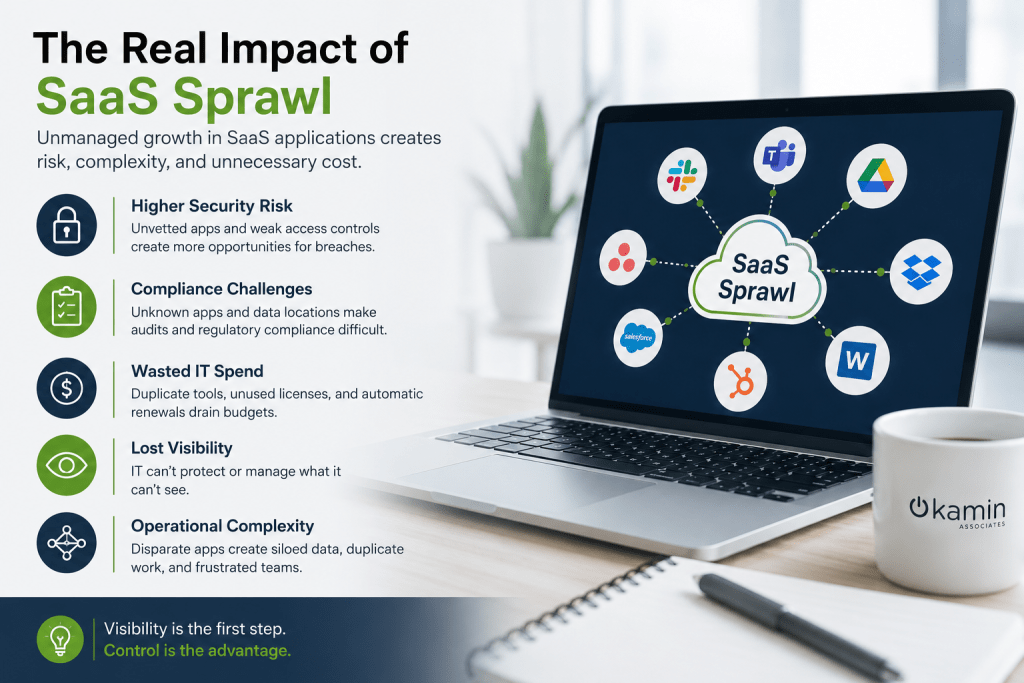
The Compliance Challenges of Unknown Software
Many organizations operate under industry regulations or contractual requirements related to data security and privacy.
Whether a company is subject to HIPAA, PCI-DSS, financial regulations, contractual cybersecurity requirements, or general data protection standards, maintaining visibility into where data resides is essential.
SaaS sprawl makes compliance significantly more difficult.
If sensitive information is being uploaded to unauthorized platforms, organizations may struggle to demonstrate proper data handling practices during audits or security assessments.
Compliance teams cannot effectively monitor what they cannot see.
In some cases, businesses may not discover compliance gaps until an audit, customer inquiry, or security incident reveals the problem.
By that point, remediation can become significantly more expensive and disruptive.
How SaaS Sprawl Increases IT Costs
While security often receives the most attention, SaaS sprawl also creates substantial financial waste.
Many organizations are surprised to learn how much they spend on unused or redundant software subscriptions.
Common cost drivers include:
- Duplicate applications performing similar functions
- Unused licenses assigned to former employees
- Automatic subscription renewals
- Department-specific tools that overlap with company-approved platforms
- Premium software features that are rarely utilized
Without regular software audits, these expenses can accumulate quietly over time.
Businesses may be spending thousands of dollars each year on software that provides little operational value.
Reducing SaaS sprawl is often one of the fastest ways organizations can improve IT cost efficiency while simultaneously strengthening security.
Best Practices for SaaS Visibility and Governance
Managing SaaS growth does not require eliminating every cloud application. Instead, organizations should focus on improving visibility and governance.
Several best practices can help.
Maintain a Software Inventory
Organizations should maintain a current inventory of all approved software applications, including ownership, licensing, integrations, and business purpose.
This creates a baseline for identifying unauthorized or redundant tools.
Standardize Software Approval Processes
Employees should have a clear process for requesting new applications.
Rather than restricting innovation, approval processes ensure software is evaluated for security, compliance, and compatibility before adoption.
Implement Identity and Access Management
Centralized user authentication allows organizations to manage access more effectively.
Single sign-on and multi-factor authentication can help reduce risk while simplifying user management.
Conduct Regular SaaS Audits
Periodic reviews help identify inactive accounts, duplicate subscriptions, security concerns, and unnecessary spending.
Regular audits provide valuable insight into how software is being used across the organization.
Educate Employees
Many employees are unaware of the risks associated with shadow IT.
Cybersecurity awareness training should include guidance on software adoption, data protection, and approved technology policies.
How Managed IT Services Help Control SaaS Growth
For many businesses, maintaining visibility across an expanding software environment can be difficult without dedicated IT resources.
Managed IT providers help organizations establish the processes, tools, and oversight needed to manage SaaS growth effectively.
This often includes software inventory management, user access reviews, cybersecurity monitoring, vendor evaluations, compliance support, and strategic technology planning.
By creating greater visibility into the software ecosystem, businesses can reduce risk, eliminate unnecessary costs, and ensure technology investments support long-term business objectives.
Bringing SaaS Back Under Control
Cloud applications have become an essential part of modern business operations. However, without proper oversight, SaaS adoption can quickly outpace an organization’s ability to manage it effectively.
The result is SaaS sprawl: a growing collection of applications that increase cybersecurity risks, complicate compliance efforts, and drive unnecessary spending.
Organizations that take a proactive approach to software governance gain better visibility, stronger security, and greater control over their technology environment.
As software ecosystems continue to expand, understanding and managing SaaS sprawl is no longer just an IT concern. It is a business priority.